Have you ever heard of One Way Glass? It’s been getting a lot of buzz across different industries because of its pretty unique features. According to reports from MarketsandMarkets, the global market for this stuff might hit around $5 billion by 2026! A big part of this growth? Its versatility—especially for security and privacy purposes. These days, more businesses are jumping on the bandwagon, using it for better surveillance and sneaky observation without making it obvious.
Now, let’s talk about why people find One Way Glass so appealing. Basically, it lets you look outside without anyone seeing inside, making it super handy for offices, shops, or even at home. But, it’s not all perfect—some folks have noticed issues with glare or poor visibility during certain times of the day. That kinda throws a wrench in its effectiveness, right? So, understanding these little quirks is pretty important if we want to get the most out of it.
In classrooms or schools, for example, One Way Glass could actually help create better learning environments. Imagine teachers being able to keep an eye on students without constantly disrupting the class. Still, how well it works really depends on how the glass is designed and where it’s placed. Striking that sweet spot between privacy and transparency isn’t always easy, but as demand grows, we’ll probably see more innovation and smarter ways to use this technology in the future.

Definition and Characteristics of One Way Glass
One way glass, also known as one-way mirror, allows light to pass through from one side while reflecting from the other. This unique property makes it an excellent choice for various applications. It is commonly used in security settings, such as police interrogation rooms or observation decks. The observer can see through the glass, but the subjects remain unaware of being watched.
In terms of characteristics, one way glass comes with a special coating. This coating reflects light effectively, creating a mirrored surface when viewing from the opposite side. The transparency depends on the lighting conditions. If it’s darker on one side, the glass works effectively; if both sides are equally lit, it loses its privacy feature.
Tips: Always test the glass under different lighting before installation. Consider the environment where it will be used. An office setting may require different properties compared to a public space.
Remember, the effectiveness of one way glass relies heavily on light control. Without proper management, it may not serve its intended purpose. It's essential to analyze your specific needs to ensure it meets privacy requirements.
One Way Glass Applications and Benefits
This chart illustrates the various applications of one way glass, highlighting its benefits in security, privacy, architecture, automotive, and electronics. Each sector demonstrates the unique attributes that one way glass can offer to enhance functionality and aesthetics.
Common Applications in Commercial Settings
One Way View Glass is becoming increasingly popular in commercial settings. It offers unique benefits for businesses that prioritize privacy and visibility. This type of glass allows people inside a building to see out while restricting outside views. Many companies utilize this feature for conference rooms and executive offices. Clients can feel secure while maintaining a professional environment.
Common applications extend beyond office spaces. Retail stores often use One Way View Glass to enhance security. Showrooms leverage its capabilities to showcase products without compromising privacy. Customers get a clear view of items inside while employees can monitor the area without distraction. However, businesses must consider lighting carefully. Daylight can amplify the glass's one-way effect, but nighttime can flip it. This inconsistency requires thoughtful planning.
Another application is in security monitoring. Many security firms utilize One Way View Glass to observe without being seen. This can lead to improved safety, but it isn’t foolproof. Situations can arise where reflections distort visibility, causing issues. In these cases, businesses must reassess their use of the material. Awareness of its limitations ensures effective implementation.
Utilization in Residential Environments
In residential environments,
Blue One Way Glass proves invaluable.
It provides privacy during the day while allowing natural light to fill spaces. Homeowners appreciate its aesthetic appeal and practical benefits.
According to industry reports, one-way glass can reduce energy costs by up to 30%.
This makes it a smart choice for those looking to enhance both comfort and efficiency.
Using Blue One Way Glass in bathrooms or living rooms can create serene retreats.
Homeowners often find that it enhances their interior design.
However, placement is crucial.
Careful consideration should be given to surrounding light sources.
Without planned positioning, the glass can lead to undesirable glare at times.
Tips: Ensure proper installation for optimal performance.
Regularly clean the surface to maintain clarity and reflectiveness.
It's essential to remember that privacy is not guaranteed at night.
When interiors are brightly lit, views may become more exposed.
Families should account for varying day-to-night light conditions when choosing their installations.
Advantages of Using One Way Glass
One way glass, also known as one way mirror, offers unique advantages in various settings. Its reflective surface allows light to pass in one direction while providing privacy from the other side. This feature is particularly beneficial in security applications, such as surveillance. An observer can see through the glass undetected. However, it may require strategic placement to ensure optimal effectiveness.
The use of Black One Way Glass enhances aesthetic appeal. It provides a sleek look while maintaining functionality. Offices and conference rooms often utilize this glass to promote privacy without sacrificing natural light. This dual benefit can improve productivity. However, one must consider potential drawbacks. Too much reflection can impair visibility in certain lighting conditions.
Another practical application is in retail environments. Store owners can use one way glass for security while still showcasing merchandise. Customers can browse without feeling watched. This balance of transparency and privacy can boost shopping experiences. Yet, the decision to install it should reflect careful planning. Regular maintenance is necessary to ensure longevity and maintain appearance.
One Way Glass Best Uses Benefits and Applications
| Application |
Benefits |
Best Use Cases |
| Surveillance |
Provides unobtrusive monitoring with privacy. |
Banks, retail stores, and museums. |
| Office Partitions |
Encourages openness while maintaining privacy. |
Open office spaces and meeting rooms. |
| Security Windows |
Increased security with the ability to see outside. |
Airports and secure buildings. |
| Display Cases |
Protects items while allowing visibility. |
Museums and retail display cases. |
| Privacy Glass |
Allows natural light while ensuring privacy. |
Restrooms and changing rooms. |
Limitations and Considerations for Use
One Way Glass has significant benefits, but limitations exist. This type of glass offers privacy without sacrificing natural light. In office spaces, it allows occupants to see out, while keeping outsiders from seeing in. However, it is important to note that visibility can change with lighting. When it's darker outside, the effect may reverse. This can create unexpected discomfort.
Usage scenarios are diverse, from conference rooms to retail stores. Nevertheless, improper placement can lead to privacy breaches. According to industry reports, about 30% of users experienced unexpected visibility issues during night hours. Such instances often require further adjustments. While One Way Glass Window can enhance aesthetics, it demands careful consideration regarding placement and environmental factors.
Temperature and glare can also affect performance. In extreme conditions, the glass may expand differently than its frame. This can lead to cracking or installation issues. A study found that nearly 15% of installations reported these problems. It's essential to consult experts when integrating One Way Glass into designs. This ensures effectiveness and reduces potential setbacks in the long run.
Comparison with Other Types of Glass
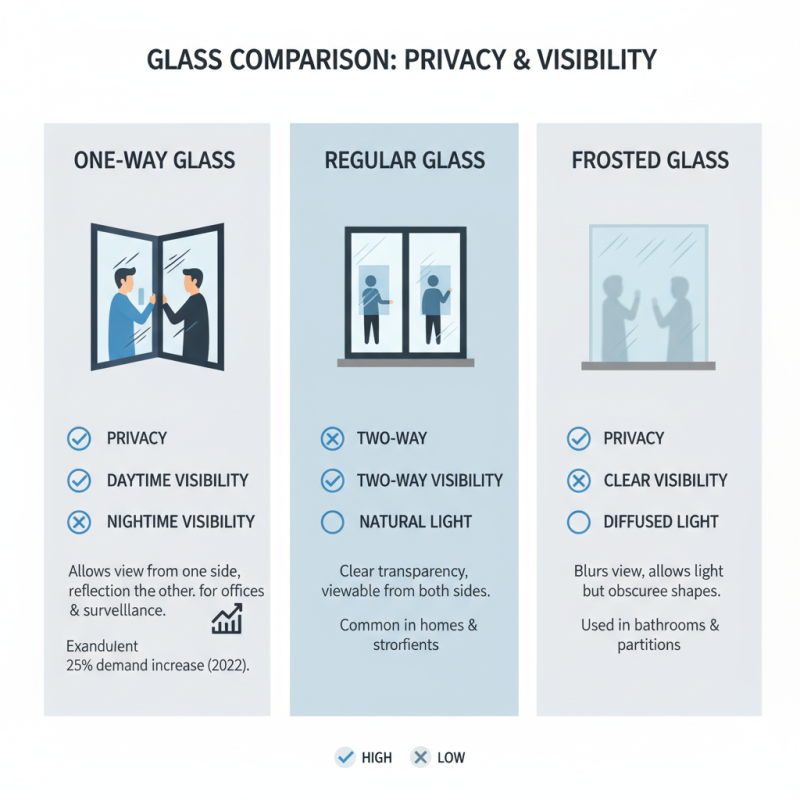
When comparing one-way glass to other types, several factors come into play. One-way glass, or reflective glass, is designed to allow visibility from one side while maintaining privacy on the other. This feature is particularly beneficial in offices and surveillance facilities. According to a 2022 industry report, demand for one-way glass has increased by 25% in commercial applications, reflecting its popularity.
In contrast, regular clear glass offers no privacy. It provides full visibility but lacks the security one-way glass provides. Laminated glass is known for its safety features but does not offer the same level of discretion as one-way options. Furthermore, tinted glass provides some privacy but can obstruct natural light. A study highlighted that 60% of clients prefer one-way glass for its balance between visibility and privacy.
However, one-way glass has limitations. During the day, it's effective, but at night, the effect reverses. If the interior lights are on, people can see in, defeating the purpose. This flaw can be critical for sensitive environments. Users must weigh these factors when choosing glass types. Consider the environment and lighting before making a final decision.
Future Trends in One Way Glass Technology
The world of one-way glass technology is evolving rapidly. This innovative material allows for privacy while maintaining visibility from one side. It has gained popularity in various applications, such as security settings and architectural designs. Emerging trends suggest an increasing interest in smart one-way glass. This new generation could adjust transparency based on environmental conditions. Imagine a room where privacy changes with the flick of a switch.
There are challenges, though. Not all one-way glass performs equally in different lighting. In certain situations, the effectiveness can diminish. Future developments will need to address this inconsistency. There’s also a growing concern about sustainability. People are calling for materials that are not only functional but eco-friendly. Explorations into recyclable options are underway. Innovations in this area could significantly impact market demands.
As we embrace technology, user awareness is vital. Many people may not fully understand the limitations of one-way glass. Education around its proper applications will be crucial. Misuse could lead to frustrating experiences. Thus, continued dialogue and research into this technology will shape its future applications and benefits.
Maximizing User Experience: The Importance of ODM Anti-Glare Tempered Glass in Electric Car Touch Control Panels
In the rapidly evolving landscape of electric vehicles, enhancing user experience is a critical priority for manufacturers. One essential component in this endeavor is the implementation of ODM anti-glare tempered glass in touch control panels. This specialized glass is designed to combat the common issues of glare and fingerprints, which can significantly hinder visibility and functionality during driving. According to recent industry reports, over 80% of drivers report difficulty using touch screens due to reflections in bright environments. The incorporation of anti-glare technology addresses these challenges effectively.
The ODM anti-glare tempered glass not only minimizes reflections but also ensures exceptional clarity across various lighting conditions. The high sensitivity of the touch interface guarantees a smooth and responsive user experience, allowing drivers to interact with their vehicle's systems effortlessly. Reports suggest that user engagement with touch controls can improve by as much as 30% when employing advanced surface treatment technologies like anti-glare coatings. Furthermore, the durability offered by tempered glass is crucial for automotive applications, as it withstands the rigors of daily use while providing additional safety features in case of damage, thereby fortifying the overall integrity of the vehicle's cockpit.
Moreover, as the automotive sector increasingly prioritizes user-centric designs, the choice of materials plays a pivotal role in shaping consumer satisfaction and safety perceptions. The ODM anti-glare tempered glass exemplifies how innovation in material science can lead to enhanced functionality and aesthetic appeal in electric vehicles, ultimately contributing to a more enjoyable and safer driving experience.
FAQS
: The product aims to provide a solution for everyday tasks. It simplifies complex processes. Many users find it helpful.
Start by reading the user guide. Follow the step-by-step instructions carefully. Practice will improve your experience over time.
Yes, some users report connectivity problems. Others find the setup challenging. It’s important to troubleshoot before seeking help.
Generally, it is designed for all users. However, some may find it complicated. Familiarity with similar products helps.
You can consult the FAQ section. Online communities may offer solutions, too. Sometimes, reaching out for help is needed.
A limited warranty is typically provided. Check the terms for specific coverage. Understanding your rights can be beneficial.
Yes, many retailers allow returns. Be sure to keep the receipt. Conditions may apply; check for specifics.
Regular cleaning is essential. Store it in a dry place. Neglecting maintenance can lead to issues.
Take time to discover all functionalities. Some features may be overlooked. Experimenting can enhance your overall satisfaction.
Updates may be released periodically. Staying informed about them is useful. Check the official website for the latest news.
Conclusion
One Way Glass, also known as one-way mirrors, is a unique type of glass that allows visibility from one side while providing a reflective surface from the other. Its primary characteristic is the ability to maintain privacy for individuals on the reflective side, making it ideal for various commercial applications such as security monitoring, police interrogation rooms, and offices where discreet observation is necessary. In residential environments, One Way Glass is commonly used in bathrooms and windows, allowing light to enter while preventing outsiders from seeing inside.
The advantages of using One Way Glass include enhanced privacy, natural light optimization, and aesthetic appeal. However, potential limitations include visibility issues under certain lighting conditions and reduced thermal performance compared to standard glass. When compared with other types of glass, One Way Glass stands out for its unique functionality, making it a popular choice in modern architecture. Future trends in One Way Glass technology may involve advancements in coatings and materials, enhancing its durability and efficiency.